
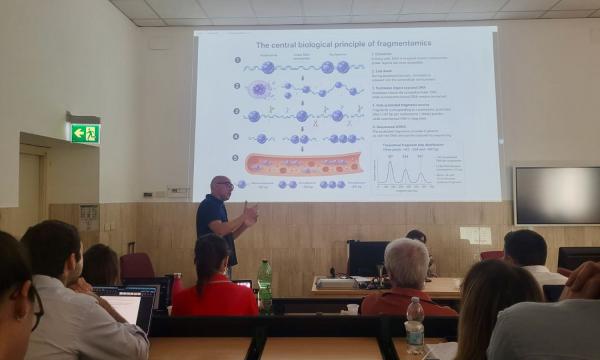
On July 2nd, 2026, Rome hosted the cfDNA Day, a specialized international seminar organized by Oxford Nanopore Technologies. The event brought together leading clinicians and researchers from across Europe to discuss the latest technological and computational breakthroughs in cell-free DNA (cfDNA) analysis.
The seminar, held at the Aula Passariello (Sapienza University of Rome), served as a vital hub for experts dedicated to pushing the boundaries of non-invasive diagnostics. With cfDNA profiling rapidly becoming a cornerstone of modern oncology, the event focused on how real-time, long-read sequencing can overcome the limitations of traditional molecular methods.
Our research group took center stage during this event, with Prof. Alberto Magi delivering an invited talk titled: "Integrated chromatin and methylation profiling of cfDNA in colorectal cancer using Nanopore sequencing". During his presentation, Prof. Magi showcased the laboratory's latest computational advancements in third-generation sequencing data analysis. He demonstrated how Nanopore technology allows researchers to extract multi-omic layers of information, i.e. genetic alterations, chromatin accessibility, and epigenetic methylation patterns, from a single sequencing run of liquid biopsy samples. In particular Prof.. Magi introduced the Window Protection Score (WPS), a quantitative measure of nucleosome protection from cfDNA fragment ends patterns, and the Window Protection Ratio (WPR), a normalized metric of nucleosome protection in cfDNA.
This integrated approach could offers unprecedented accuracy in tracking tumor dynamics and identifying biomarkers critical for colorectal cancer progression.